Four areas of opportunity, and an institution built to serve them for the long term.
India Tomorrow Foundation is conceived as a long-horizon institution that deepens public understanding, informs policy, convenes ideators and decision-makers, and seeds ideas that governments, markets, and civil society can scale.
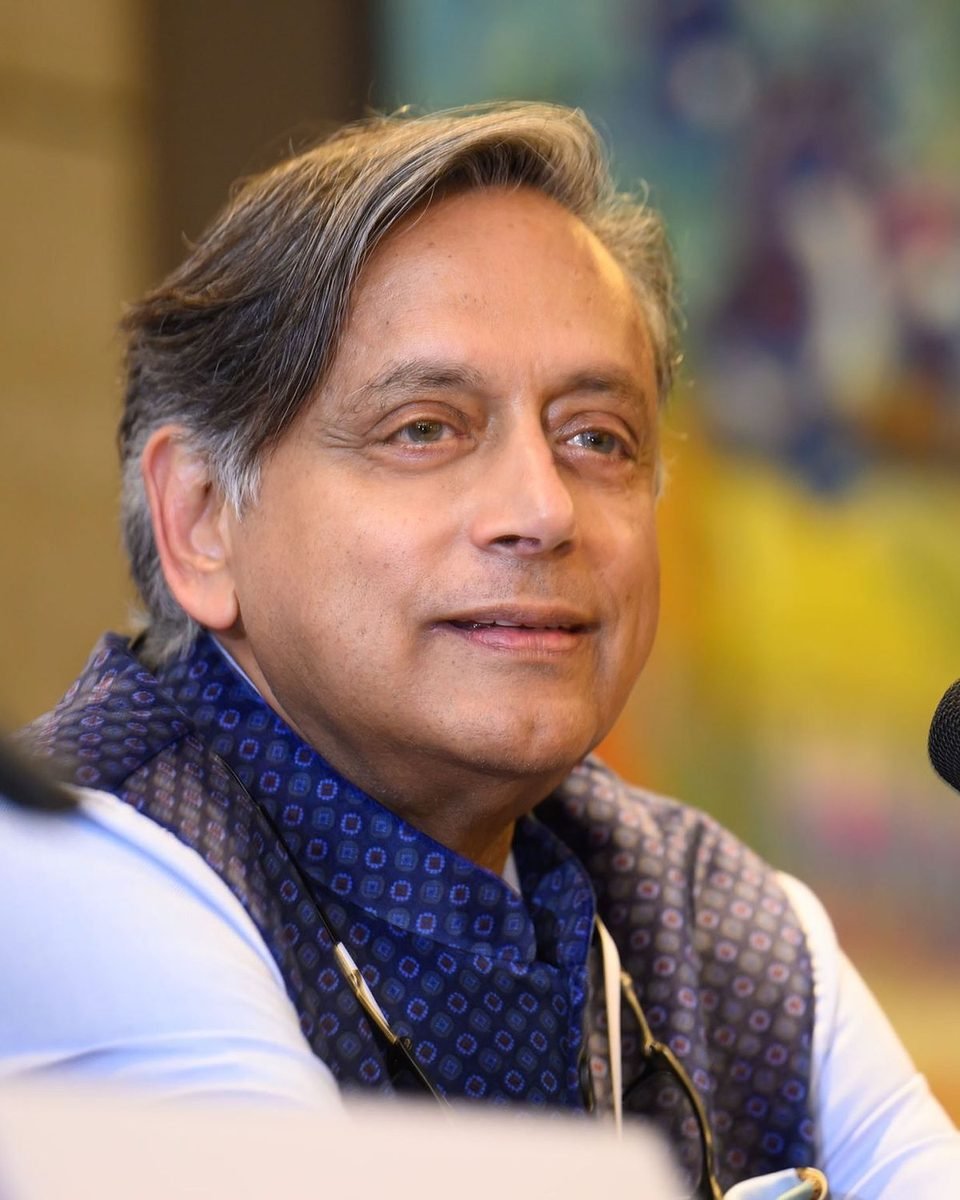
Dr. Shashi Tharoor
Dr. Shashi Tharoor conceptualised the Foundation as a vessel for the ideas and principles he has developed over a life spent across several worlds. He completed a PhD at the Fletcher School of Law and Diplomacy at 22, then spent nearly three decades at the United Nations as a peacekeeper, refugee worker and administrator, rising to Under-Secretary-General and, in 2006, standing as India's candidate for Secretary-General. That understanding of how the world works, and of how India is seen within it, informs the Foundation's work on foreign policy and international affairs.
His twenty-nine books of fiction and non-fiction, honoured with the Sahitya Akademi Award, the Commonwealth Writers' Prize and the Crossword Lifetime Achievement Award, make a long argument for India's culture, history and pluralism, and the Foundation carries that argument into literature, the arts and public conversation. In his fourth term as a Member of Parliament, and as one of the first Indians in public life to speak with the public directly through social media, he has engaged with people from every part of India and across the world, and what he has heard from them shapes the Foundation's focus on education, opportunity and the communities that need it most.
Honoured in India and abroad, with the Pravasi Bharatiya Samman, Spain's Order of Charles III and France's Légion d'honneur among his awards, he now brings that experience, thinking and conviction together in one institution that can put them into practice, with real and measurable impact on communities across India. The Foundation is being built with patience, care and independence so that this work can be carried forward for generations.
What the Foundation exists to do
India's economy has grown fast over the last two decades. Its institutions, its public conversation and its investment in people haven't kept pace. The country's hardest problems are long-term and structural, but short-term pressures keep rewarding quick fixes. That's the gap the Foundation is built for.
The Foundation will deepen public understanding, inform policy, convene ideators and decision-makers, and seed ideas that governments, markets, and civil society can scale. It will also undertake ground-level initiatives, including operating educational institutions or hospitals, to demonstrate scalable impact.
Most of these problems don't need brand-new answers. Good solutions often exist already. What's usually missing is a trusted room where people who disagree can look at the evidence together and work out what to do, and then someone willing to see it through. The Foundation wants to be both.
We'll keep the permanent team small and lean on visiting fellows and partner organisations, and we won't repeat work that others already do well.
At its core, the Foundation rests on the belief that India's future will be determined as much by ideas, values, and institutions as by capital and technology.

Where good solutions already exist, and trusted spaces for open deliberation help them take root.
Peacock, sun rays, and grace
The peacock has been part of how India sees itself for centuries. Krishna wears its feather in his crown. Shah Jahan named his throne after it. In folk songs across the country, it dances to welcome the monsoon. And since 1963 it's been India's national bird.
Across regions and faiths, it's come to stand for grace, beauty and renewal. That's what we hope the Foundation's work will bring, wherever it reaches.
Behind the peacock, the sun is coming up. In Indian thought the sun has long meant light and knowledge, and a sunrise is the simplest sign there is of a new day. That's the tomorrow in our name.
Light also means openness. Sunlight, as the saying goes, is the best disinfectant. We want the Foundation to work in the open, so its ideas can be tested and its results seen by anyone who wants to look.
Five commitments that govern every initiative.
The Foundation operates at the intersection of ideas, research, and action. Every intervention is held to the same standard.
Independence
Intellectual and operational autonomy, in service of the long-term interest.
Evidence-driven
Every initiative grounded in rigorous research and reliable data.
Multiplicative impact
Seeding ideas and networks that existing institutions can scale.
Long-horizon thinking
Root causes and structural outcomes over immediate wins.
Inclusivity & pluralism
Diverse voices from administration, academia, and civil society.
A four-step intervention logic.
Many of India's most complex questions already have promising solutions, and trusted spaces for open deliberation help those solutions take root.
-
Generate
Credible, synthesised knowledge: research, studies, surveys, and consultations across social, economic, cultural, and ecological questions.
-
Convene
Influential stakeholders across public life, administration, academia, and culture, in spaces designed for serious and open deliberation.
-
Shift
Decision-making circles, moving them towards action and towards systems thinking.
-
Catalyse
Adoption by institutions and donors and, where engagement can accelerate impact, direct implementation of programmes.
What the Trust exists to advance.
Education & skilling
Advancement of education, vocational training, digital literacy, and livelihood enhancement.
Health & nutrition
Promotion of healthcare, preventive healthcare, nutrition, sanitation, and public health.
Welfare & inclusion
Support for women, children, senior citizens, persons with disabilities, and other communities in need of support.
Environment
Sustainability, ecological balance, conservation, climate resilience, and air and water quality.
Technology & public services
Data-driven and AI-enabled solutions that improve institutional efficiency, public outcomes, and service delivery.
Governance & accountability
Stronger coordination, long-term planning, and accountability, so that public institutions deliver lasting results.
Culture & heritage
Preservation and promotion of art, culture, literature, languages, and traditional knowledge.
Festivals & public dialogue
Festivals, forums, exhibitions, and public conversations that widen access to literature, history, and ideas.
Foreign policy & international affairs
Non-partisan research, dialogue, and exchanges on India's place in the world and its external relationships.
Research & policy
An academic, research and policy institution, run strictly on a non-partisan, non-political basis.
Institutions
Schools, colleges, hospitals, clinics, libraries, and community and cultural centres.
Fellowships & grants
Scholarships, research fellowships, mentorship, and merit-based awards.
Youth & leadership
Student interactions, mentorship, and leadership programmes for young people across India.
International partnerships
Exchanges and partnerships with educational, cultural, and policy institutions around the world.
CSR implementation
Acting as an implementing agency for corporate social responsibility projects.